This is not a post about politics, although the subject line could apply there equally as well. This is about running. Not simply about running, but about the running industry, the people and the shoes in particular.
Age has crept up on me and distance running is likely not in my future, but over the years I’ve accumulated a bit of knowledge and lots of opinions about the sport and the equipment. I’ve been fortunate to work part-time in one of the country’s 50 top running stores for a number of years, and below are some of my observations.
I started working in the running store in 2011, and continued to do so until COVID-19 made a mess of things in 2020. During those years I was subject to numerous training programs about shoes, socks, orthotics, compression sleeves, hydration, nutrition and even sports bras. Being shut down, I continued to work my full-time career until I retired three years ago. After growing bored and poorer, I was welcomed back to the store where I continue to work part-time to this day. But oh my, how things have changed!
When I began distance running, the “minimalist” shoe movement was in effect. Nike, which had effectively started the running shoe industry in 1974 when Bill Bowerman, Nike co-founder, used his wife’s waffle iron to create the first “waffle trainer,” also introduced the Nike Run Free shoe, which was shown in advertisements being rolled nearly into a ball.

How the Nike Free Run could be rolled
I ran two marathons in Nike Free shoes, and I still have a pair with the Marine Corps Marathon timing chip fastened to the laces.
Other brands followed suit, and I owned New Balance Minimus, Mizuno Wave Evo Cursoris, Saucony Kinvara and a few other brands. I trained and got used to the feel of the ground, and to this day still believe that proper running (and walking) for involves understanding where the ground is.
Which is why when I returned to the running store, I was aghast at how running shoes had changed. I have told many customers that the goal of every running shoe company is to make shoes so light that if one opened the box lid, they would float right out. The challenge was always the rubber. Adding rubber to the outsole of a running shoe would always invariably add weight to them. Then adding a stability wedge (a “medial post” as it’s often called) would add even more weight. The trade-off was a heavier shoe if stability was a need.
But science and technology marches on. Shoe makers developed new formulations of “rubber” — now referred to as “foam” that made it lighter. Injecting this foam with bubbles of nitrogen made it still lighter and “spongier.” Soon shoe companies were adding “stack height” (the height of the outsole, usually seen from heel to toe) to make shoes super-soft and cushioned. New brands like Hoka and On sprang up, where the dominant feature was the foam cushioned stack. Other brands followed suit. The first day I arrived to work on my return, the look of the shoes lining the wall was a shock to one used to “traditional” running shoes.
Nike is no different. Their original “Pre Montreal” running shoe and its modern equivalent are show below.

Original Nike Pre Montreal running shoes
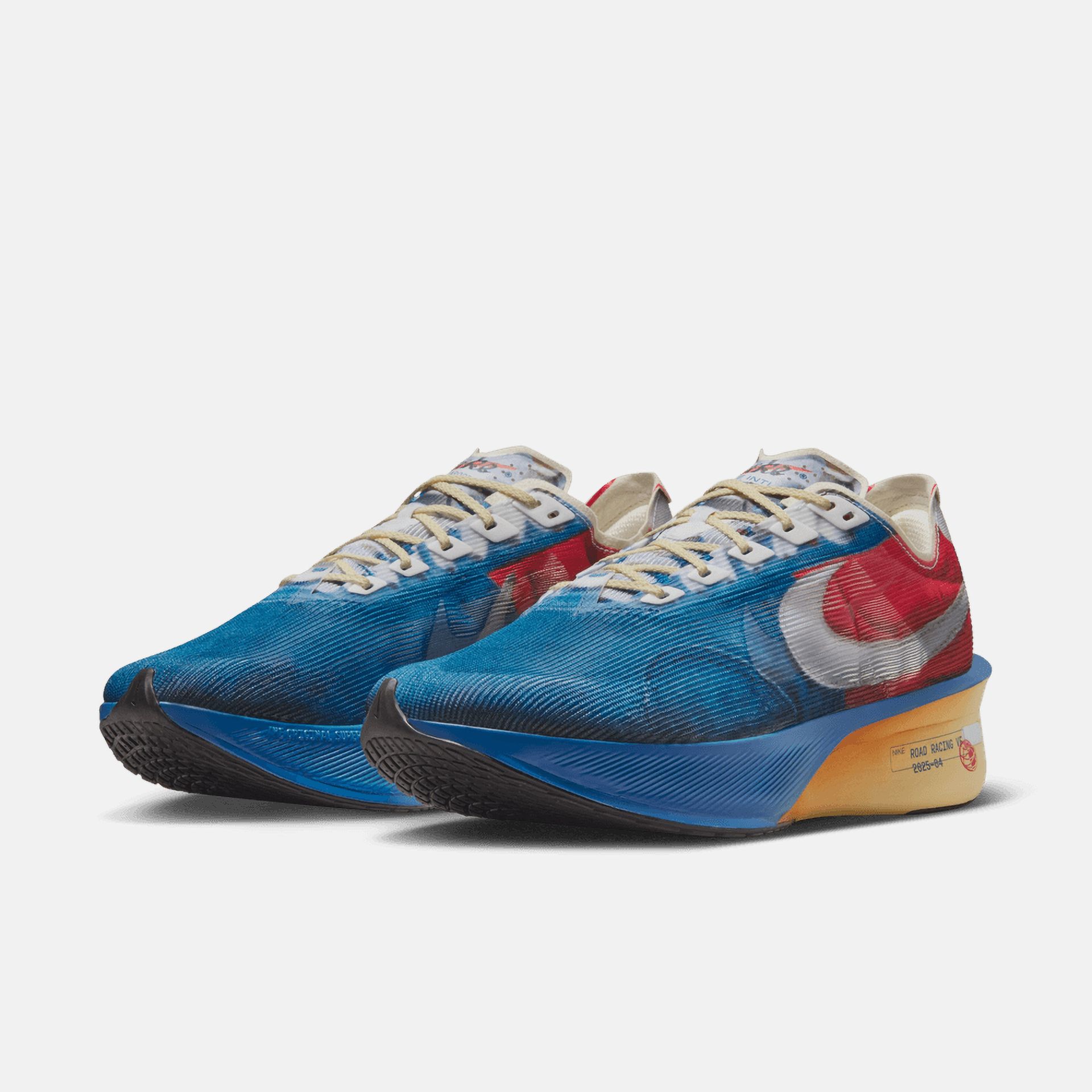
Nike Vaporfly 4, the latest evolution of Nike’s original super shoe, embodies the spirit of the Pre Montreal
A benefit I get from working a the running store is that shoe companies will sometimes “seed” shoes to employees. The marketing belief is that people will see employees wearing their shoes and want to learn more, with the intent to purchase. Since February of 2026, I have been the recipient of no less than seven pairs of shoes! My collection now includes shoes from Hoka, On, Mizuno, Puma, Nike, Adidas, and even a pair of Oofos!
Every one of them is a bouncy, marshmallow-feeling shoe. I think by now I’m getting somewhat used to the feel, but I still think I want to sense the ground. That’s probably just me, and the way I learned over the years, but I think it also highlights the role of marketing in the running shoe industry.
I might be called to task for this statement, but here goes: Not every person needs shoes specifically matched to their gait. What do I mean by this? One of the diagnostics we perform in the running store is a gait analysis, where we look at the feet, arches and ankles of the customer. Our primary interest is to see if the person overpronates, is neutral, or even supinates.
Pronation is the natural movement of the human foot. When walking, a person lands on the heel, which is actually on the outside of the foot, not the center. As the step continues, the foot rolls through the midfoot and then typically exits through the big toe. Overpronation occurs when the medial arch flexes during the gait, causing an inward “roll” of the ankle. Supination is the reverse, and of the three is the rarest type. Since shoes aren’t usually made to protect against supination, running shoes are made into two categories: Neutral and Stability (a third, Motion Control is a high-end stability shoe). Supinators are usually fitted into neutral shoes. Sorry about that.
But here’s where my title enters into the story. Some of the best runners in the world have what experts would call “poor” running form. Englishwoman Paula Radcliffe, a multiple women’s marathon winner and two-time world record holder. With those credentials, it’s hard to make a case for her running form. But ask anyone in the know and they will immediately speak of her unorthodox “head bob” and gangly gait.
Many elite runners exhibit severe overpronation. Take a look at this video
For me then, recommending a stability shoe over a neutral shoe is a matter of judgment. I look at the person’s gait, of course, but I also engage them in conversation to get an understanding of how experienced they are, how often they run, how “body aware” they are, and perhaps what goals they have set for themself. Putting a person into the wrong type of shoe can result in over-correction, and that’s almost as bad as no correction.
The foot and ankle consist of 26 bones, 33 joints, 112 ligaments and four arches. fully one-quarter of the body’s bones are found in the feet. Seeing as many feet as I do in the shoe store, I understand that there is truly no “one-size fits all” solution to fitting running shoes.
Above all else, comfort is the #1 deciding factor in choosing a running shoe. That’s how you run your own race!