The More We Know, The More We Know

WHATEVER YOUR OPINION OF TUCKER CARLSON, HIS INTERVIEW WITH JOHN RICH BEARS WATCHING.  In fact, whatever your opinion of John Rich, the same holds true.

Neither should need introducing, but Tucker has been a presence–some may say an irritant–in the public eye since he was a Fox News host.  He has since become an independent podcaster and still roils the waters.  John Rich is a successful songwriter, former bassist for the band Lonestar, half of the super-duo Big & Rich, and a solo artist and podcaster.

John Rich. Photo courtesy johnrich.com

The title of Tucker’s interview show is, “John Rich on Diddy, Demons, the Antichrist, How to Hear God, and His War on Child Predators.”  Raised a Christian, Rich only recently became outspoken about his faith, and in the interview sometimes even comes across as a bit of a preacher.  Given that his father was a pastor and his second album was titled “Son of a Preacher Man,” this should come as no surprise.

What fascinated me about the interview was Rich’s insistence that evil exists, and effectively demon-possesses many people.  The struggle between evil and good is real, and his way of identifying it is clear, stark and startling.  People often overlook, ignore or pretend that this struggle does not exist, but Rich won’t let the viewer off the hook.  It’s real, and he wants us to know it.

The headlines on a nearly daily basis underscore Rich’s point.  Reports of pedophilia abound–globally, not just in the U. S.–and Rich cites Jesus in the Bible, ““If anyone causes one of these little ones—those who believe in me—to stumble, it would be better for them to have a large millstone hung around their neck and to be drowned in the depths of the sea.” (Matthew 18:6 NIV).  Stumble.  Not stray, not fall, not wander away.  Rich plainly says Jesus thinks anyone who even causes a child to stumble in his faith, should die.  And here we are: The stories of Jeffrey Epstein and his alleged child-trafficking and the elite clientele he served are only one example of the deprivation that has befallen America.

The cases of corruption uncovered by the Department of Government Efficiency (DOGE) reveal billions of dollars missing, misdirected or squandered through USAID.  Unfettered immigration policies have resulted in Somali criminals absconding with billions through welfare fraud and schemes and Afghan murderers.  Election fraud, insider trading, the granting of commercial drivers licenses through phony schools to illegal immigrants.  Without understanding the language or the rules of the road, fatal accidents involving them are on the rise.

Often, people will want to point the finger of blame at people like George Soros and his son, Alex.  The fawning media like to portray “the man who broke the bank of England” as a philanthropist, but to many he is a naked globalist, pursuing his “Open Society” initiative. Doing so runs contrary to the Constitution of the United States, which is why there is so much animosity aimed at him.  But Soros isn’t the actual problem.  The evil which has taken over him is to blame.  Proverbs 4:16 warns that the wicked “cannot sleep unless they do evil” and “are deprived of slumber until they make someone fall.”

How and when did this come to be?  That’s actually not the right question.  The question, as echoed by John RIch, and by one of my Christian brothers, is found in 2 Chronicles 7:14, “If my people, who are called by my name, will humble themselves and pray and seek my face and turn from their wicked ways, then I will hear from heaven, and will forgive their sin and will heal their land.” (NIV).  The evil one has managed to get people to turn away from God.  The only solution is to turn back again, as the verse above proclaims.

Ripe? Rope? What’s With the Asterisk?

I SAW THIS MEME AND IT REMINDED ME OF A CURIOUS TREND.

That trend is the use of an asterisk in place of one or more letters in a word.

It’s no challenge to mentally replace that asterisk with the proper character, the letter “a.”  The intention of the meme is to infer rape statistics have increased due to mass migration policies.

This article isn’t going to debate the veracity of the claim, but simply to wonder who finds this form of “masking” useful?  There are at least two other characters in the English language that fit this pattern, giving the words “ripe” and “rope.”  Neither makes sense in the context of the message, so the obvious word is, “rape.”

I find this neither ingenuous nor clever.  I am not aware of any web site, platform or media outlet that bans the word “rape.”  Sadly, too many news reports list this crime of violence and use the word openly.  So, why do people think it’s necessary to do so?

Asking Perplexity.ai (one of the best AI engines, in my opinion, as it displays the sources along with its results) the reason some people feel the need to do so yielded a lengthy exposition, many sourced from another social media site, Reddit, that indicated various possible motives.  The two I like best are

  • It works to bypass algorithms on some sites that consider some words “dangerous” or “triggering.”  Yes, some sites still have “nanny” bots.
  • It makes the reader auto-complete the word–a reading “hiccup” as it were.  This puts an emphasis (intended or not) on the word.

Speculation exists that some sites that have a specific focus might want to avoid listing words that might act as triggers.  However, what level of genius is required to decipher masked words like, k*ll, s**cide, t*rrorist, and the aforementioned r*pe?  Software developers and implementors who feel this type of censorship have a very low opinion of their users and customers.

Rational adults don’t need to be censored, and you won’t find such artifice here.  A reprimand my mother used on more than one occasion has stayed with me:  Vulgarity is immaturity personified.  The use of a word for its shock value has nearly completely disappeared, as has been demonstrated by Democrats in the media lately.  Some people are incapable of speaking without peppering their speech with curse words.  I have no time for them.

(This is the first article I’ve posted since ‘reclaiming’ my independence from Substack.  I hope to continue to write articles here, and hope you enjoy reading them.  Comments are welcome–but are moderated, so if you choose to respond, be kind, be clean, be intelligent!).

Once Burned, Twice Shy

THE LONGER I REMAIN ON SUBSTACK THE MORE I REALIZE what a petrie dish for the worst society has to offer it has become.

I tried out two public sites offering writers the opportunity to get a wider audience for their work, Medium and Substack.  Not wanting to duplicate my efforts, and feeling Substack had better tools and a wider reach, I gave up on Medium.  Maybe that was a mistake.

The radio is perhaps my primary source for information as well as entertainment, and hearing references to noted personalities and journalists like Julie Kelly having Substack pages helped push me in that direction.

However, a harsh reality has struck.  As was recommended to me by another (unnamed purposely) Substack  member, my audience is not other Substackers!  The recommendation made by this respondent to my post was to start mentioning my Substack page on other social media sites. Ugh.  But that’s the world today: You have to put yourself out there and then drive the eyeballs to you.

Pause for a moment to mention in a semi-hypocritical way, that I despise “social media.”

My fault was in thinking that Substack wasn’t social media, but was a platform for serious writers.  At first, the founders attempted to deny the fact, but then co-founder Hamish McKenzie on the Substack blog admitted that it was a social media platform, after all.

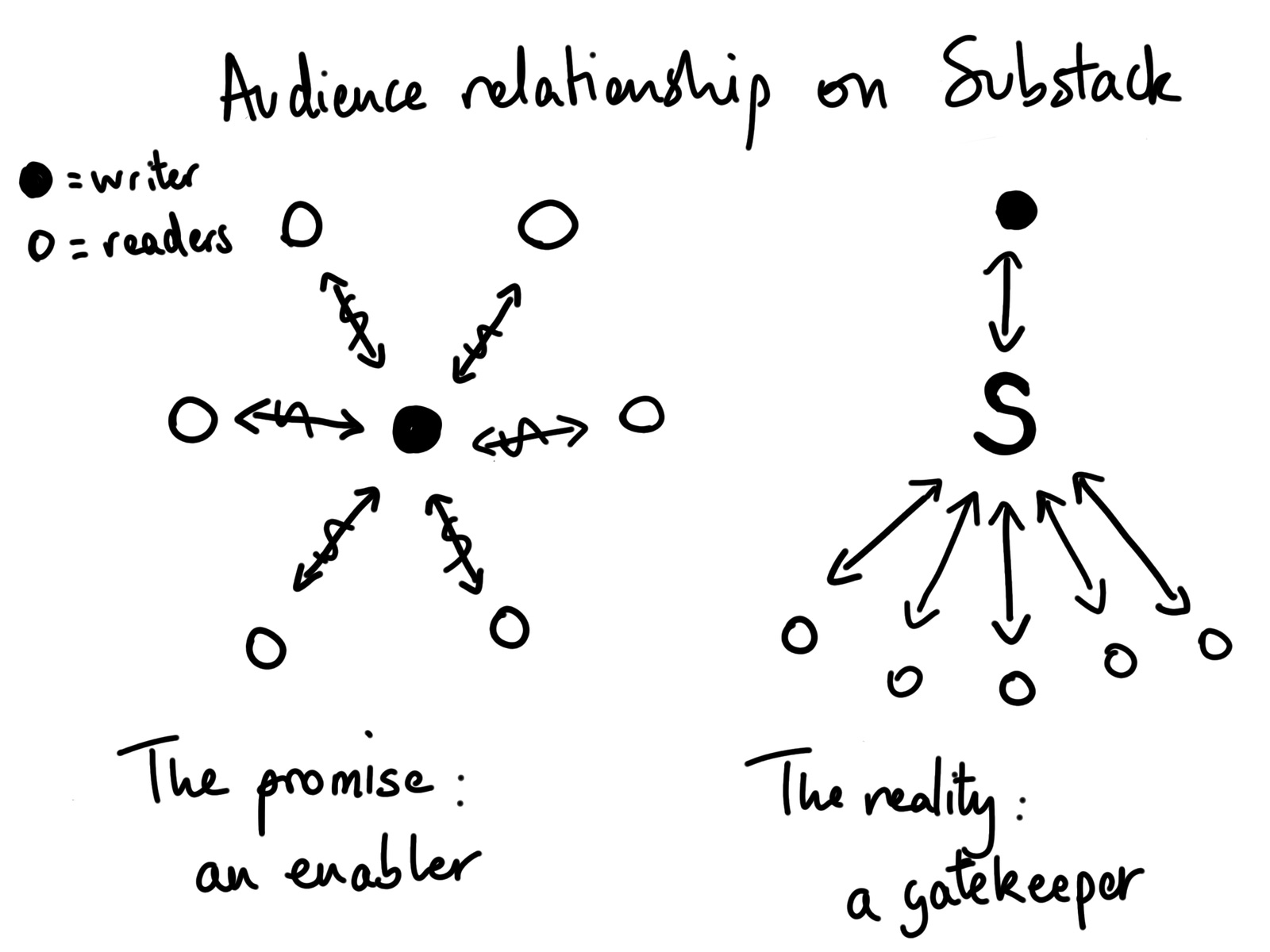
In her article “We’ve been thinking about Substack all wrong,” author Isabelle Roughol writes,

Substack pretends to be the CMS that powers the new independent media era, when it’s really a platform of the old scale era. The second you look at Substack as social media, it starts to look a whole lot better. I’m even ready to argue that as social platforms go, Substack is one of the better ones for creators in a field that is notoriously exploitative. It’s easy to use out of the box (sort of). It enables fast growth (that’s at least half real). It provides transparent(ish) monetisation. It lets you (mostly) own your audience list. It doesn’t cost you a thing until you earn something (then it takes quite a bit of it). That’s why I see little harm in larger publishers such as New York Magazine trying out Substack as part of a broader social portfolio or creators using it as a process blog, without intending to make it their main income.

She includes a nifty hand-drawn graphic:

sketch: promise-vs-reality

Isabelle Roughol’s sketch on Substack’s promise-vs-reality

I have personally experienced her observation that “It enables fast growth (that’s at least half real).”  Over the past few months, I’ve seen substantial “growth” in (free) subscribers, yet a cursory examination of those new subscribers suggests that 50% of them aren’t real.  They are ‘bots, scammers, or both.  Yes, I have been scammed!

My “Spidey sense” is now heightened.  For the time being, I continue to write on Substack, but I don’t respond to subscribers until I’ve vetted them.  That simply means that I check their profile page and check to see how many posts they’ve written.  If the number is zero, I disregard them as troublemakers, miscreants, or maybe even criminals.  In other words, I ignore them.

Fool me once, shame on you.  Fool me twice, shame on me!

The sheer irony of all this is that it seems I’ve come full circle.  I founded this site/page in 1996.  Substack arrived much, much later — in 2017.  The beauty of having my own site is that I control everything about it.  I’ve just never tried to promote it.  So, in my unnamed source’s view, perhaps I should just drop Substack and focus on publishing and promoting my own content.  If I can’t believe Substack’s subscription metrics, why should I bother?

SCAMMED!

I HAVE NO ONE TO BLAME BUT MYSELF.  I write this as a cautionary note.  Perhaps someone reading this might be warned against falling prey as I did.  Here is my story, and the red flags I missed (or ignored).  If this is TL;DR, scroll to the bottom for the recap.

The scam I fell victim to was based on the concept of “AI Arbitrage.”  As we should know by now, AI stands for “Artificial Intelligence.”  It’s the hottest thing going in the computer world.  The premise is that AI can be used to trade crypto currencies much like day trading on the stock market.  Since AI purportedly works at computer speeds, it buys and sells crypto as the prices fluctuate across markets.  Sounds plausible, right?  It did to me.

In July of 2025, I began writing in earnest on Substack (see my previous post).  At one point, I received a comment from a reader who seemed interested in what I was writing, and we began exchanging chat messages.  This person was identified only by a first name and last initial:  Mary H.  The chats were pleasant, and I enjoyed some personal interaction.  At one point she suggested moving to Telegram, as a better means to continue to communicate.  That should have been a red flag, but at the time I didn’t see it as such.

We continued to have friendly chats.  I should mention that Mary presented herself as a 30-ish divorcée, a small business owner and entrepreneur living in California.  Let me say right here that having an intimate relationship with a woman younger than my daughter was never a motivating factor!  She was nice, and I often mentioned the disparity in our ages and life experiences.  We were simply “friends.”  Toss out the idea of a sexual “honey pot.”  In fact, greed wasn’t my motivation either.  I think the fascination of technology was what got me.  However, the age difference between us should have been a red flag, also.

Our original conversation on Substack is still saved, so I can retrace back to the beginning.  One red flag I definitely saw was that Mary’s profile on Substack was gone.  Her avatar and username were still listed, but her presence on Substack is missing.  In my ignorance, I thought perhaps she wasn’t into writing and had simply quit the site.  Substack only timestamps the date and time a conversation begins and not every message, so I can only report that the first saved message with Mary occurred on July 24, 2025.  By July 26, the conversation had edged into the territory of money.  She asked if I’d read the book, The Psychology of Money, by Morgan Housel.  I confessed that I had not, but checked it out from my library.  We continued to chat about the book, other books and topics in general, and then on July 28, she asked me about my thoughts on AI.  As one who spent his career in the technology field, we talked about the current state of tech, and then on July 29, she asked if I’d heard of AI Arbitrage.  Looking back, it’s amazing that all this took place in just a few short days!  Another red flag!

So it began.  Over the messaging capabilities of the Telegram app, Mary walked me through the process of creating a bitcoin “wallet,” transferring money from my bank to a crypto exchange and converting it to the bitcoin of choices.  In this case, it was Ethereum, one of the more popular crypto currencies.  The next step was to deposit the crypto into an account on the AI arbitrage account.  Finally, submit an order.

Newcomers are allowed to “sample” the system by opening a very limited two-day order.  But only twice.  At this point, I was playing with “mad money,” which came straight out of my checking account.  I thought that if I lost it, it would be a lesson learned, but not the end of the world.  I made my two orders and each returned a profit, which I converted back to cash and sent to my bank.  I made $465.89.  For doing nothing!  Since I had used the available two-day orders, the promise of greater returns on a three-day order appealed to me, with an additional influx of cash.

Uh-oh.  You can see where this is going.  I had the cash in my checking account, so it was a simple matter to wire the funds needed as before and enter the order.  Nothing to it!  Three days later, I saw a nice, but not obscene return, so I thought to repeat the process.

I won’t say that greed didn’t enter into my decision.  I’d like to think that it would be a nice “cushion” to have in my retirement funds.  Maybe pay off a car loan.  Donate to the church.  Maybe some home improvements.  I wasn’t thinking “overnight millionaire,” but perhaps I was relishing the idea of splurging a bit.

Then came the first disaster.

According to the “rules,” which I never saw, if a three-day order cannot be filled due to no available “slots,” the “system” automatically moves the order up to the next “tier,” which in this case was a five-day order.  The only problem now was that in order for a five-day order to be submitted, sufficient funds to cover the system-allocated amount were required.  I did not have these funds in my checking account, so under assurances that I would be able to withdraw those funds upon completion of the order, I went to my retirement financial advisor and requested a withdrawal from there.  Order satisfied, completed, and all was in order.  I did this twice.  At one point, Mary even added some of her own funds to help me make the minimum amount.

Mary had mentioned that I should become a “VIP” member, which would allow me to set fine-grained limits on future orders, but when I inquired, I was told my “bank” was short the required amount.  Oh well, all I had to do was place three-day orders and set a limit on the allocated funds.  I did so, and it worked out.  By now, I had actually seen some profit, even though there was more work involved than I’d thought.  Still, I already had funds in my “bank” so I placed another order.

And waited.

Nearly 24 hours later, I saw on my dashboard that I was registered for a nine-day order!  From a three-day order to a nine-day order was extraordinary.  The problem was the funds needed to complete the order.  However, I was tapped out.   I had no more funds in my retirement account, no income save for Social Security and what had previously been my savings.  As I write this, five days remain until I lose my (figurative) shirt.

RECAP

To restate the original line, I HAVE NO ONE TO BLAME BUT MYSELF.  Below are the red flags I should have seen and the warnings some due diligence would have kept me from being scammed:

  1. An unknown person with no traceable identity reaches out and engages in conversation.  Okay, that in itself is fairly benign, but when asked to take it to Telegram (or another platform–especially one I don’t use–is a warning flag.
  2. This same person does not have, or no longer has an account on Substack where we first connected.
  3. When AI Arbitrage was mentioned, I should have done better research.  I did some cursory investigation, but mostly on the technology, which is why it first appealed to me.
  4. Querying perplexity.ai about AI Arbitrage scams has yielded a wealth of information.  It’s likely the only wealth I’ll see from all this.  I won’t paste everything, but here are the salient points.
  • Scammers set up convincing platforms, apps, or trading bots that claim to use advanced AI.
  • They leverage buzzy jargon.
  • Victims are pressured to deposit money, often encouraged by staged fake returns (they might allow a small withdrawal at first to build trust). The platform may show simulated profits but prevents withdrawals once larger sums are deposited, using excuses like extra fees or system upgrades.
  • Some scams involve fake arbitrage bots or smart contracts advertised on social media
  • Romance and social engineering tactics are sometimes used, where trust is built over time before introducing the “AI arbitrage” investment opportunity

Other than the last item, and there no romance was involved, but I can’t dismiss social engineering, the list isn’t a clear tip-off.  However, there’s more.

Hallmarks and Red Flags
• Guaranteed profits or “no risk” claims—no real trading system or AI can provide this.
• Poor transparency: legitimate AI trading services explain risk and show verifiable results, while scams hide details.
• Use of fake testimonials, deepfakes, AI-generated videos, or false celebrity endorsements to build false credibility.
• High-pressure tactics such as limited-time offers or bonus incentives to deposit more money.
• Platforms mimicking real, regulated firms or using “clone” branding to build unwarranted trust.
• Fake signals: some services charge for “AI-powered trading signals” that are randomly generated or plagiarized, not actually using AI

Again, none of these hallmarks stand out, but if nothing else, there are a lot of ways to be taken.

Notable Variants
• “Pig butchering” scams, where trust is built over time with small, staged returns before the victim is encouraged to invest larger amounts.
• Crypto “arbitrage” bots advertised in videos or forums, with code that directly steals funds as soon as it’s deployed.
• AI-powered phishing, fake customer support, and voice-cloning used in combination with investment scams or to elicit credentials and wallet keys
Well, if anything, it looks like I fell to the “pig butchering” scam!  I’m also not enamored of the customer support, as it has sometimes seemed “robotic.”
It’s too late for me–I’ll survive, but I’ll live out the rest of my days much poorer.  Here are some of Perplexity’s prevention recommendations.
Prevention Tips
• Be skeptical of any offer guaranteeing profits or using a lot of hype around AI, quantum, or arbitrage trading.
• Do research—verify the company’s licensing and reputation independently from the platform’s site.
• Avoid sending funds to unfamiliar platforms, and never share wallet keys or personal info with unknown parties or bots
I wound up losing over $400,000 to this scam.  That was most of my retirement savings.  I’m not going to starve, I’m not going to commit suicide, but my life has been changed irrevocably.  I’m too old to earn that all back again, so I now have to keep a closer eye on my expenses, and perhaps even find a part-time job.  Lessons learned.
PART II COMING SOON

The Substack Route

I have recently begun writing articles on Substack.

Substack logo

Substack logo

Those articles are much like the articles I write here, but they have a wider, built-in audience.  I have never made the effort to drum up readership here, and as a result, this site is mostly a forgotten breadcrumb on the Internet.

This is not a complaint.  When I first began the Music For A New Age web site, my main purpose in doing so was to learn and implement HTML.  As the years passed, the site morphed into what is seen today:  A WordPress blog site.

Using the site as a “sandbox” has allowed me to employ it as a development platform.  I’ve created a “pseudo-forum” as a proof-of-concept (which was not accepted by my then-employer), a storage mechanism for files and data I could access anywhere an Internet connection existed, an exploration of cascading style sheets (CSS), which is now the landing page at https://www.mfna.org.

My Substack is where I am actively developing my writing skills.  In my opinion, the writing tools are less flexible than are WordPress’s, but the main point of my doing so is that I get readers without having to do any promotion.  Thus, I can improve my writing, and the feedback I receive helps me do so.

There is a bit of a concern I have.  Substack has numerous categories one can scroll through, search, and “silo” articles.  I have not found a way to categorize my articles there as I can here.  My as-yet-unproven sense is that authors who stick to a specific category get more readers.  One of the writers I follow, Julie Kelly, an investigative reporter, writes exclusively about politics.  I have neither the expertise nor the discipline to always write on a single topic.  I have multiple interests, and write about what I know, what I’ve seen, what I’ve experienced and what I I wish for.

So, my Substack isn’t replacing this site.  In the long run, perhaps it will make my writing here better.

That Voice

This is not about the TV spectacle that features singers competing for money and prizes.  Or maybe just money.  I don’t know; I’ve never watched it.  To its credit, it’s been on the air for 27 seasons (number 28 is due this Fall).  That’s a pretty good career for anyone associated with it, so kudos to them.

No, this is about something much more mundane.  It’s also pretty shallow, if I say so myself.  But this is my site, so I can be as pedantic, snarky or narcissistic as I wish.  You don’t pay for my opinions, and as the site’s subhead states, everyone is entitled to it. That doesn’t mean you have to agree, or even read further.

Now, three paragraphs in (have you noticed how many articles on the web don’t get to the point right away?  What’s with that?) I’ll lay the groundwork.

In my college years, and even some years before, radio was the “source medium” of the day. It was how we got our news, weather and sports reports. Then television began shoving radio aside, and today both are ancient technologies due to the Internet.  But they persist.

Several times during those years I was told, “You should be in radio.”  Maybe it was because people thought I had a face for radio (rimshot!) or they honestly thought I had a voice that was suited for it.

A Face For Radio

It was fairly common knowledge at the time that there were schools for people wishing to enter the field.  The Columbia School of Broadcasting {link unavailable} was perhaps the best known. I should note that the Columbian School of Broadcasting is not affiliated with Columbia University, which has its own school of journalism and broadcasting.  In addition, there is a Connecticut organization with the same name.  I’m not going down that rabbit hole.

Broadcasting schools were there to train and educate those interested in a career in broadcasting (duh).  Among the courses offered were voice lessons, which covered topics such as diction, pacing, tone and presentation.  Successful completion of a course might lead one to a position in the broadcast industry, and the cream of the crop would find themselves in front of a microphone.

My father was an avid listener to the Harden & Weaver program, broadcast weekday mornings on WMAL Radio, which at the time was on the AM band at 630 (it is still Washington, D. C.’s most popular talk radio station, now broadcasting on the FM band at 105.9).  Full of humor, topical news and personalities that wouldn’t quit, Frank Harden and Jackson Weaver both had voices made for radio (there is a book about them here).

A “radio voice” is not necessarily stentorian, but the schools would train them to be resonant, well modulated, clear and articulate, warm and inviting.  Harden & Weaver epitomized these characteristics.  Don Ameche (1908–1993) was not only a golden voice, but an Oscar-winning actor.  As was James Earl Jones, without whose voice Darth Vader might have been little more than a cartoon character rather than the menacing evil who made the Star Wars franchise famous.

Star Wars Poster

The original Star Wars movie poster (no credit to Jones, although the Vader image prevails)

Rush Limbaugh is another voice that typifies the attributes listed above.  Whether you agreed with his politics or not, his voice was a commanding presence on the airwaves for more than 30 years.

There are an awful lot of radio personalities now that fail my personal “broadcaster test.”  Not to detract from some very successful on-air personalities like Wolfman Jack and Mark Levin, both of whom have pedigrees longer than my arm (the Wolfman actually graduated from the National Academy of Broadcasting in Washington, D.C.) but I have a tolerance level for voices that growl, scratch, croak, squeak or scream.  Sorry to say, Mark Levin’s voice alone is the main reason I don’t listen to him.  That he’s intelligent, well-read and loves dogs is a given.  But his voice is the broadcast equivalent of scraped chalk on a blackboard (or, if that’s too old of a reference, how about a fork scraping a plate?), especially when he gets excited.  I’d wager Levin is not a broadcast school graduate!  I am a fan, although not a rabid one, of local sports teams, but the radio outlet here hosts a number of on-air types who may know every stat, number, play and player, but whose voices are so unlistenable that I refuse to tune to their station.  Thirty seconds of mumble, screech and what-have-you are all I can take before switching stations.

I really do enjoy listening to radio voices that entertain me, don’t speak down to me, don’t pander, and most of all, don’t offend my ears.  If I can’t find a radio program I like, I turn on some music.  Problem solved!

A View From The Bottom

…of the barrel, that is.

The sports world is agog at the re-emergence of perhaps the greatest baseball player to ever play the game, Shohei Ohtani.  Taking the mound for only the second time after his Tommy John surgery, Ohtani threw 18 pitches and recorded two strike outs against the Washington Nationals on June 22, 2025.

Photo of Shohei Ohtani throwing one of 18 pitches, June 22, 2025

Shohei Ohtani throws one of 18 pitches, June 22, 2025 (AP Photo/Jessie Alcheh)

What has gone largely unnoticed by all but the Washington Nationals fans is that Ohtani’s performance was less impressive than was the pitching of Nats’ starting pitcher, Michael Soroka.  During his five-plus innings on the mound, Soroka registered a career-high ten strikeouts and held the Dodgers to two hits.

Photo of Michael Soroka pitching

Michael Soroka pitching against the Dodgers (Kiyoshi Mio-Imagn Images)

While Soroka was on the mound, the Nationals managed to bring home three runs, and led the Dodgers (last year’s World Champions, and contenders again in 2025) to none. Before leaving the game, Soroka struck out Ohtani twice.

Then, as happens all too frequently with the Nats, the starter was replaced by the bullpen, and the whole thing unraveled. Soroka’s stuff disappeared in the sixth inning, and in came a parade of relievers, who, when the dust had cleared, had given up 11 runs.

When the score reached 13-3 (including Ohtani’s 5 RBI), Dave Roberts, manager of the Dodgers used an existing rule that states any team that is ahead ten runs or more, can use a utility player in place of a pitcher.  This is effectively a “mercy rule.” So, on came Enrique “Kiké” Hernández, a utility player who immediately surrendered four runs to the Nationals in the top of the ninth before he was replaced by an actual pitcher, who ended the game.  Final score: Dodgers 13, Nationals 7.  It wan’t that close.

This “Tale of Two Ballgames” underscores the most glaring problem the Washington team has faced all year:  The worst bullpen in baseball!  Let’s face it, the Nats have only one big bat on the team, and that is swung by rookie James Wood (although the Nats sit at number 14 on the home runs list).  Called up in July, 2024, Wood is in only his first full season, and has already shown himself to be a long-ball threat.  When the bats are swinging, the Nats can put up big numbers.  Sadly, that happens infrequently.

Fielding is also problematic.  The Nationals have been bringing up young talent in a frenzy, hoping new, young blood will solidify the defense.  Injuries and unfilled expectations have reduced the defense to being 26th out of 32 teams in the league.  The offense is hardly better, ranking 22nd.

There’s a long climb out of the bottom.

How NOT To Gain Customer Confidence

I have become interested in writing software again.  I guess that’s what retirement does for you.

Having spent 40+ years in the computer field, and having worked in a variety of disciplines, I started to research computer-related programs, projects and technologies.  I’m old enough to admit that I wrote COBOL code for a living, back in the 1980s-1990s.  I thoroughly enjoyed it, and those who deride it don’t deserve the consideration of a reply from me.

So, imagine my surprise and pleasure to learn that COBOL isn’t a dead language, and in fact has been updated and improved over the years.

COBOL Program Snippet

Traditional COBOL Program portion

Even better, there is a popular open-source COBOL compiler that not only supports the latest and greatest variants of the language, but is documented nine ways to Sunday, GnuCOBOL.  I quickly downloaded it, both on a Mac and on my Linux server (because both platforms are supported).  The Linux version required a little wrangling to get it operational, but the Mac version was a piece of cake.  Mind you, this is only the compiler.  Programmers write code in text editors or integrated development environments (IDE) and then compile them into executable code.  I have editors, but I also found several IDEs because they can make the task of writing and compiling code a little easier.  VScodium is one such, and OpenCobolIDE 4 is another.  Unfortunately, the OpenCobol product is no longer being developed or supported.

For the technology-inclined, and something I found quite impressive, is that GnuCOBOL actually create C code that is then compiled into machine code.  I like this, because the resulting executable code is not “bloated,” which has always been the complaint about COBOL since its inception.

I’ve now spent a couple of weeks re-learning COBOL, and finding out how it has evolved over the past 40 years.  Many of the features have been enriched, such as using END- declaratives (e.g., END-IF, END-PERFORM, etc.).  The format of the source code has been loosened, and a “free format’ structure is supported, meaning column restrictions have been removed, and commenting code now include inline comments.  Nice!

But it doesn’t stop there.  During a conversation with a former co-worker, I mentioned that I’d created a program for in-house use at my employer about 30 years ago using a quirky English product called Omnis 7 from a company called Blyth Software.  Curious, I went looking for it and found that the program is still actively developed and sold, now as Omnis Studio, and the company is now Omnis Software.  I referred to it as “quirky” because internally, some of the language used in the product was distinctly “British,” and took some adjusting to.

Happily, I found that Omnis offers a free “Community Edition” for developers and limited deployments There is also an embarrassing wealth of resources available to the developer.  Naturally, I downloaded the product, and in an unusual (for the Mac) move, found I needed to add some tutorial files to the “hidden” Application Support folder on the Mac (this is less uncommon under Windows, and this is a cross-platform product).  This is where my limited mindset sabotaged me:  Where to start?

To its credit, Omnis offers pretty much everything except their source code.  The documentation is all online.  There are YouTube videos.  Webinars are offered. There is “Omnis Academy” that offers other self-structured lessons.  As I said, where do I start?

The answer came, in a manner of speaking, from Omnis itself.  In order to use the community edition, one still needs a license to activate the software, so my email was required, and naturally, I received an email from an account manager following up.

Here’s where it gets weird.  Or, maybe I should say, “quirky.”  One of the resources offered is a developers online forum.  I’ve joined a number of such communities, and found them to be  invaluable in helping get answers to questions that may not be covered in the documentation or the training.  So I went to sign up.  That’s when I was surprised that after submitting my online application for membership, I was greeted with a screen informing me that I’d been blacklisted.  Excuse me?  What?  Trying multiple computers, multiple browsers and multiple email accounts made no difference.

But I do have to tip my hat to Omnis, because I registered for a webinar and found I was the only attendee.  Thus, I was able to spend 90 minutes with a system engineer/support tech going over the fundamentals of the program.  But neither he nor the account manager were able to resolve the issue of my inability to register for the forum.  I’m probably being a bit too harsh on Omnis, as the people there I’ve worked with have been eager to help, just not able to fix that one issue.  And they know that I’m not a paid developer working to complete a project.  I am simply a tech-curious retiree trying to keep increasing my knowledge.  In fact, until I started down this path, first with COBOL and now with Omnis, I had no real purpose in mind.  But now I do.

Going back to near the beginning, as I was writing COBOL under contract for the federal government, I was tapped to be on a special project using a then-popular program, dBASE III+, published by the Ashton-Tate company (an interesting side note is that in the early 1980s, the ‘Big Three’ in the nascent software industry were Lotus, WordPerfect and Ashton-Tate; names that are all but forgotten today).

dBASE was among the first database management systems (DBMS) for the PC.  It ran under DOS and had many cool features.  I note that dBASE still exists today, but as a mere shadow of itself.  And is not cross-platform, so as a Mac user, it’s not even under consideration.  After I became expert in dBASE, I took my knowledge and built an entire office football pool system with it.  It even included a “splash” screen!  I briefly toyed with the idea of turning it into a shareware program, but even compiled dBASE code could be reverse-engineered, and I wasn’t sure if it would have any acceptance worth my time to support.

The source code for my “shareware” program is long gone.  Those were the days of 5-1/4″ floppy disks, so even if I have a copy stored around someplace, I have no way of restoring it.  So, to keep me occupied, I’m thinking of rebuilding it from scratch.  Using Omnis.  I think the program is great (it’s lasted longer than the “big three,” after all).  But it seems there are some loose ends internally within the company.  Which isn’t the best way to inspire confidence.

Still, it’s only if I get the program developed and choose to market it, will they make money from me.  So, it’s understandable if they don’t bend over backward for me.  They have a right to not have confidence in me!

A Frustrated Nats Fan Speaks

As a boy growing up the son of a government official in the D. C. area, I became a fan of the hapless Washington Senators baseball team.  To this day I still remember the saying:  “Washington – first in war, first in peace, last in the American League.”  When my dad took me to games at the old Griffith Stadium, I was in Cracker Jack heaven!  We used to spend warm night out on the porch listening to games on AM radio.

Cracker Jack Box

“Buy me some peanuts and Cracker Jack…”

Not once, but twice, the Senators left town for greener pastures.  Today’s Minnesota Twins and Texas Rangers are the result of this transplantation.  For 33 years, the nation’s capitol had no professional baseball (the Baltimore Orioles lured some Washingtonians to their cause, but that wasn’t for me).  Then in 2005, Major League Baseball, which had taken over the Montreal Expos, relocated the team to Washington, where the team became the Nationals.  Baseball in D. C. was back!

The first few years were typical of an expansion team.  A bright spot was the club’s first draft choice, Ryan Zimmerman, who spent his entire playing career with Washington, wearing #11.  The team’s fortunes turned in 2012, and for the next seven years the club finished the season in either first or second place in their division, culminating in a World Series Win in 2019 – the first World Series victory in Washington since 1924!

Those who say one can’t buy a World Series are wrong.  The Nationals had spent a lot for talent taking them to the Series.  After the victory, the unloading began, with the high-priced players being traded or released.  2020 was the year of COVID, and an abbreviated season was played.  The Nationals went 26-34, finishing last in the National League East.  Not an aberration, apparently, as they finished last the next three years.  Having embarked on a “youth movement,” much was made of players they acquired through trades, the draft, and the farm system.  Finishing 2024 with the same record (71-91) as they did in 2023, they miraculously finished in fourth place by dint of the Miami Marlins having an even worse record.

As I write this, the 2025 season is still young.  With only 19 games in the books, the Nationals are 7-12 (a .368 rating – worse than the three years before).

I’m hoping that I’ll be able to come back to this page in September and read it with chagrin.  At present though, it doesn’t appear the Nationals are any better than the 71-91 teams of the past couple of years.  That’s frustrating!


Why I Will Never Buy a Product From André Assous

Not long ago, I received an email advertisement from someone or something named André Assous.  I had never heard of this brand, so I thought nothing of it and deleted  the email.

But I continue to get advertisements, now quite obviously spam messages from this André Assous.  The little bit of research I did on this name reveals that there actually is such a person, and there is such a company.  Apparently they are a shoe company.

I have never bought shoes from André Assous, and at this point I won’t be buying shoes from them.  This is why, short and sweet.

Since I had never heard of André Assous, André Assous obviously heard of me by buying my email address.  Okay, I know that’s done all the time; it’s part of how the Internet functions.  On a whim, I clicked on the “unsubscribe button in the email.  Now, I know well enough not to do this, but I was curious to see what would happen.  Believe it or not, sometimes this actually does work!  But not in this case.  The unsubscribe button in the André Assous is a dead end.  André Assous isn’t even polite enough to throw a “404” (page does not exist) error, it’s just a blank, dead page.  Thanks, André.  (The U. S. Federal Trade Commission has a mostly unhelpful web page about Unwanted Emails,, Texts and Mail, in case you’re interested).  More than likely, André Assous is making more money by selling email addresses than by selling shoes.

So, quite obviously, I am somehow now forever cursed to receive spam from André Assous. And while I can’t stop them from sending them, the wonderful SpamSieve software from C-Command makes it so I never have to see them.  In the end, the good guys win out.

(I have purposely used André Assous’s name many times in this post.  If he or his company scrape the web looking for references, I hope they read this.  And know that I curse you and will never hesitate to give you and your company a bad opinion).