
I have become interested in writing software again. I guess that’s what retirement does for you.
Having spent 40+ years in the computer field, and having worked in a variety of disciplines, I started to research computer-related programs, projects and technologies. I’m old enough to admit that I wrote COBOL code for a living, back in the 1980s-1990s. I thoroughly enjoyed it, and those who deride it don’t deserve the consideration of a reply from me.
So, imagine my surprise and pleasure to learn that COBOL isn’t a dead language, and in fact has been updated and improved over the years.
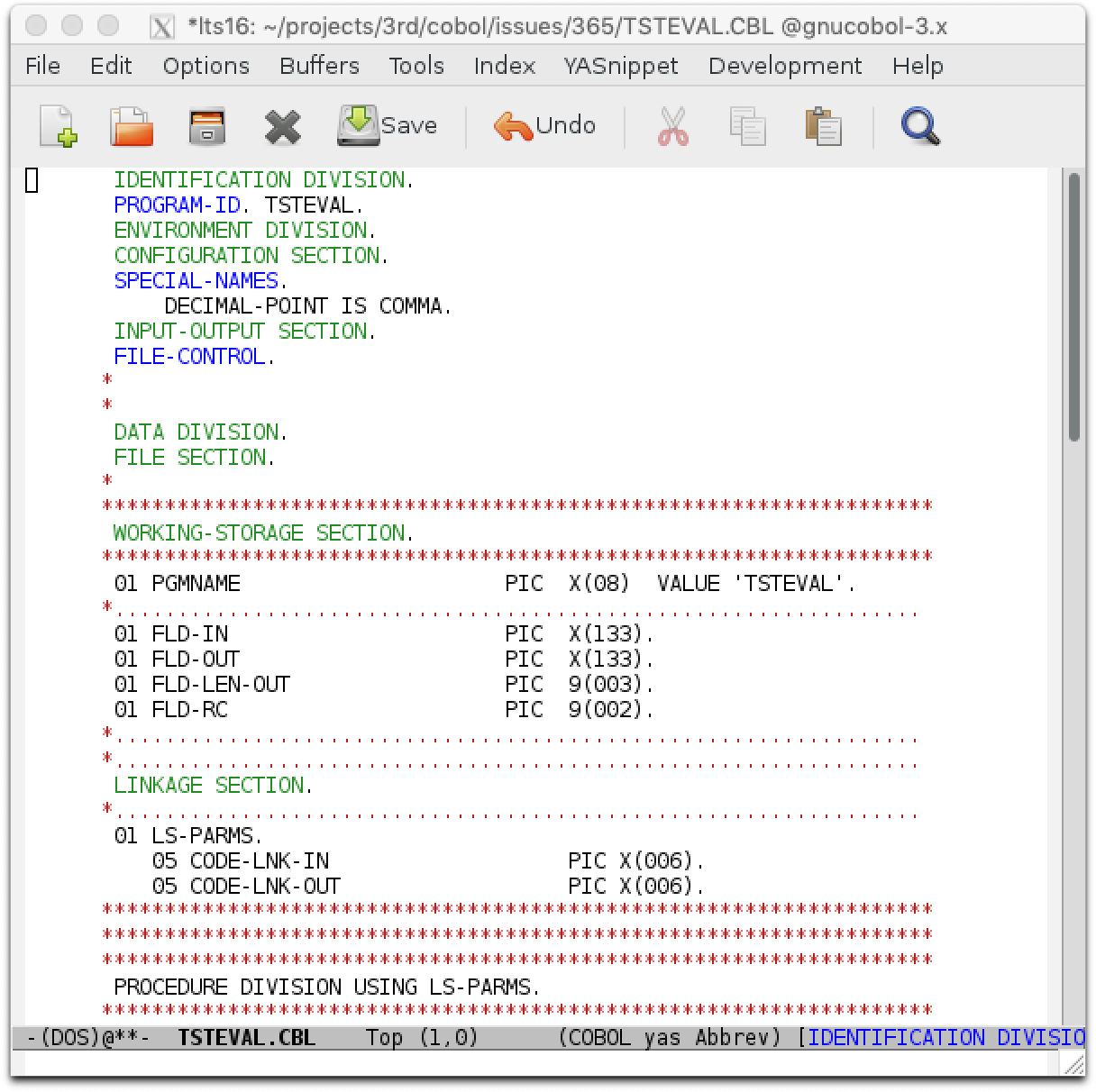
Traditional COBOL Program portion
Even better, there is a popular open-source COBOL compiler that not only supports the latest and greatest variants of the language, but is documented nine ways to Sunday, GnuCOBOL. I quickly downloaded it, both on a Mac and on my Linux server (because both platforms are supported). The Linux version required a little wrangling to get it operational, but the Mac version was a piece of cake. Mind you, this is only the compiler. Programmers write code in text editors or integrated development environments (IDE) and then compile them into executable code. I have editors, but I also found several IDEs because they can make the task of writing and compiling code a little easier. VScodium is one such, and OpenCobolIDE 4 is another. Unfortunately, the OpenCobol product is no longer being developed or supported.
For the technology-inclined, and something I found quite impressive, is that GnuCOBOL actually create C code that is then compiled into machine code. I like this, because the resulting executable code is not “bloated,” which has always been the complaint about COBOL since its inception.
I’ve now spent a couple of weeks re-learning COBOL, and finding out how it has evolved over the past 40 years. Many of the features have been enriched, such as using END- declaratives (e.g., END-IF, END-PERFORM, etc.). The format of the source code has been loosened, and a “free format’ structure is supported, meaning column restrictions have been removed, and commenting code now include inline comments. Nice!
But it doesn’t stop there. During a conversation with a former co-worker, I mentioned that I’d created a program for in-house use at my employer about 30 years ago using a quirky English product called Omnis 7 from a company called Blyth Software. Curious, I went looking for it and found that the program is still actively developed and sold, now as Omnis Studio, and the company is now Omnis Software. I referred to it as “quirky” because internally, some of the language used in the product was distinctly “British,” and took some adjusting to. 
Happily, I found that Omnis offers a free “Community Edition” for developers and limited deployments There is also an embarrassing wealth of resources available to the developer. Naturally, I downloaded the product, and in an unusual (for the Mac) move, found I needed to add some tutorial files to the “hidden” Application Support folder on the Mac (this is less uncommon under Windows, and this is a cross-platform product). This is where my limited mindset sabotaged me: Where to start?
To its credit, Omnis offers pretty much everything except their source code. The documentation is all online. There are YouTube videos. Webinars are offered. There is “Omnis Academy” that offers other self-structured lessons. As I said, where do I start?
The answer came, in a manner of speaking, from Omnis itself. In order to use the community edition, one still needs a license to activate the software, so my email was required, and naturally, I received an email from an account manager following up.
Here’s where it gets weird. Or, maybe I should say, “quirky.” One of the resources offered is a developers online forum. I’ve joined a number of such communities, and found them to be invaluable in helping get answers to questions that may not be covered in the documentation or the training. So I went to sign up. That’s when I was surprised that after submitting my online application for membership, I was greeted with a screen informing me that I’d been blacklisted. Excuse me? What? Trying multiple computers, multiple browsers and multiple email accounts made no difference.
But I do have to tip my hat to Omnis, because I registered for a webinar and found I was the only attendee. Thus, I was able to spend 90 minutes with a system engineer/support tech going over the fundamentals of the program. But neither he nor the account manager were able to resolve the issue of my inability to register for the forum. I’m probably being a bit too harsh on Omnis, as the people there I’ve worked with have been eager to help, just not able to fix that one issue. And they know that I’m not a paid developer working to complete a project. I am simply a tech-curious retiree trying to keep increasing my knowledge. In fact, until I started down this path, first with COBOL and now with Omnis, I had no real purpose in mind. But now I do.
Going back to near the beginning, as I was writing COBOL under contract for the federal government, I was tapped to be on a special project using a then-popular program, dBASE III+, published by the Ashton-Tate company (an interesting side note is that in the early 1980s, the ‘Big Three’ in the nascent software industry were Lotus, WordPerfect and Ashton-Tate; names that are all but forgotten today).
dBASE was among the first database management systems (DBMS) for the PC. It ran under DOS and had many cool features. I note that dBASE still exists today, but as a mere shadow of itself. And is not cross-platform, so as a Mac user, it’s not even under consideration. After I became expert in dBASE, I took my knowledge and built an entire office football pool system with it. It even included a “splash” screen! I briefly toyed with the idea of turning it into a shareware program, but even compiled dBASE code could be reverse-engineered, and I wasn’t sure if it would have any acceptance worth my time to support.
The source code for my “shareware” program is long gone. Those were the days of 5-1/4″ floppy disks, so even if I have a copy stored around someplace, I have no way of restoring it. So, to keep me occupied, I’m thinking of rebuilding it from scratch. Using Omnis. I think the program is great (it’s lasted longer than the “big three,” after all). But it seems there are some loose ends internally within the company. Which isn’t the best way to inspire confidence.
Still, it’s only if I get the program developed and choose to market it, will they make money from me. So, it’s understandable if they don’t bend over backward for me. They have a right to not have confidence in me!