THE LONGER I REMAIN ON SUBSTACK THE MORE I REALIZE what a petrie dish for the worst society has to offer it has become.
I tried out two public sites offering writers the opportunity to get a wider audience for their work, Medium and Substack. Not wanting to duplicate my efforts, and feeling Substack had better tools and a wider reach, I gave up on Medium. Maybe that was a mistake.
The radio is perhaps my primary source for information as well as entertainment, and hearing references to noted personalities and journalists like Julie Kelly having Substack pages helped push me in that direction.
However, a harsh reality has struck. As was recommended to me by another (unnamed purposely) Substack member, my audience is not other Substackers! The recommendation made by this respondent to my post was to start mentioning my Substack page on other social media sites. Ugh. But that’s the world today: You have to put yourself out there and then drive the eyeballs to you.
Pause for a moment to mention in a semi-hypocritical way, that I despise “social media.”
My fault was in thinking that Substack wasn’t social media, but was a platform for serious writers. At first, the founders attempted to deny the fact, but then co-founder Hamish McKenzie on the Substack blog admitted that it was a social media platform, after all.
In her article “We’ve been thinking about Substack all wrong,” author Isabelle Roughol writes,
Substack pretends to be the CMS that powers the new independent media era, when it’s really a platform of the old scale era. The second you look at Substack as social media, it starts to look a whole lot better. I’m even ready to argue that as social platforms go, Substack is one of the better ones for creators in a field that is notoriously exploitative. It’s easy to use out of the box (sort of). It enables fast growth (that’s at least half real). It provides transparent(ish) monetisation. It lets you (mostly) own your audience list. It doesn’t cost you a thing until you earn something (then it takes quite a bit of it). That’s why I see little harm in larger publishers such as New York Magazine trying out Substack as part of a broader social portfolio or creators using it as a process blog, without intending to make it their main income.
She includes a nifty hand-drawn graphic:
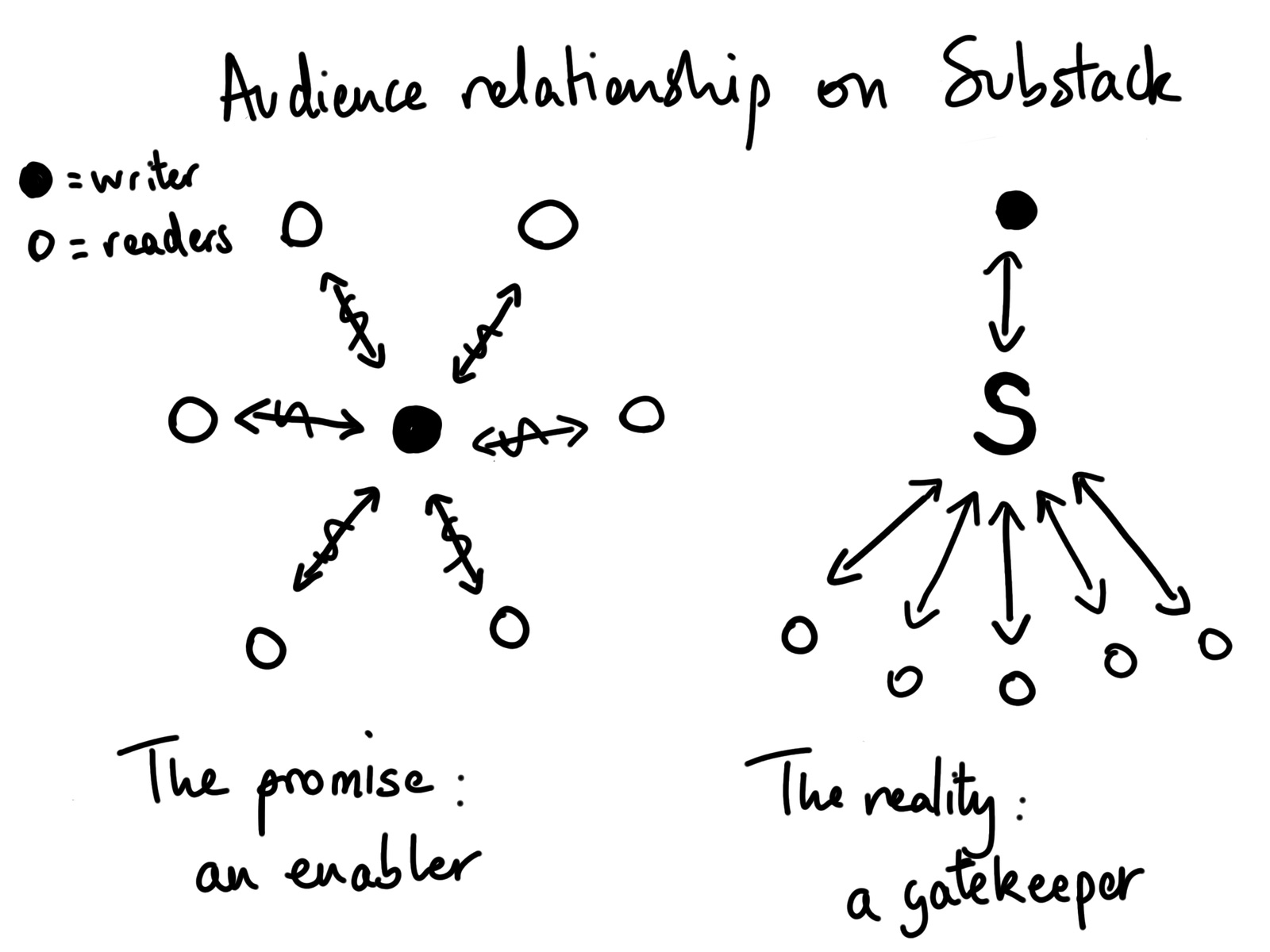
Isabelle Roughol’s sketch on Substack’s promise-vs-reality
I have personally experienced her observation that “It enables fast growth (that’s at least half real).” Over the past few months, I’ve seen substantial “growth” in (free) subscribers, yet a cursory examination of those new subscribers suggests that 50% of them aren’t real. They are ‘bots, scammers, or both. Yes, I have been scammed!
My “Spidey sense” is now heightened. For the time being, I continue to write on Substack, but I don’t respond to subscribers until I’ve vetted them. That simply means that I check their profile page and check to see how many posts they’ve written. If the number is zero, I disregard them as troublemakers, miscreants, or maybe even criminals. In other words, I ignore them.
Fool me once, shame on you. Fool me twice, shame on me!
The sheer irony of all this is that it seems I’ve come full circle. I founded this site/page in 1996. Substack arrived much, much later — in 2017. The beauty of having my own site is that I control everything about it. I’ve just never tried to promote it. So, in my unnamed source’s view, perhaps I should just drop Substack and focus on publishing and promoting my own content. If I can’t believe Substack’s subscription metrics, why should I bother?